Threat analysis for vehicles, done in hours, not weeks.
TARA Engine turns an ECU description into a complete, standards-grounded Threat Analysis and Risk Assessment: assets, damage scenarios, threats, attack paths, risk ratings and cybersecurity controls, ready for review and export.
TARA is mandatory. Manual TARA doesn't scale.
Every vehicle type needs a documented cybersecurity risk assessment for type approval. Teams still do it in spreadsheets, one ECU at a time, with results that depend on who held the pen.
Weeks per ECU of workshops and spreadsheet edits for each variant.
A full first draft in one run, generated from your ECU definition and reviewed by your experts.
Inconsistent coverage: threat categories and attack paths get missed.
Systematic STRIDE coverage for every asset, with configurable depth.
Hard to trace back to the standard clause during audits.
Grounded in the standards through retrieval over your knowledge base, with R155 traceability.
One engine for the whole TARA lifecycle
Model the architecture, generate the analysis, refine it with your team and export audit-ready reports.
Visual architecture canvas
Draw ECUs, interfaces and external systems on an interactive diagram. Assign confidentiality, integrity, availability and extended properties directly on each node and connection.
AI generation grounded in standards
A retrieval-augmented pipeline pulls relevant passages from ISO 21434, R155, threat catalogues and past reports before each section is generated.
Expert-in-the-loop editing
Every damage scenario, threat and attack path is editable inline. Add custom entries, adjust impact ratings and archive items, with an audit trail of changes.
Consistent risk scoring
Impact × feasibility risk matrix per ISO 21434, with four impact dimensions (safety, financial, operational, privacy) and an auto-derived overall rating.
R155 compliance gap view
Map generated threats to the UNECE R155 Annex 5 catalogue and see which threats and mitigations are covered and which still need attention.
Audit-ready exports
Export the full report as Word, the risk matrix as Excel, or machine-readable JSON for your toolchain, with your branding throughout.
See it in the product
Screenshots from TARA Engine, taken from an over-the-air (FOTA) update assessment and a battery management system architecture.
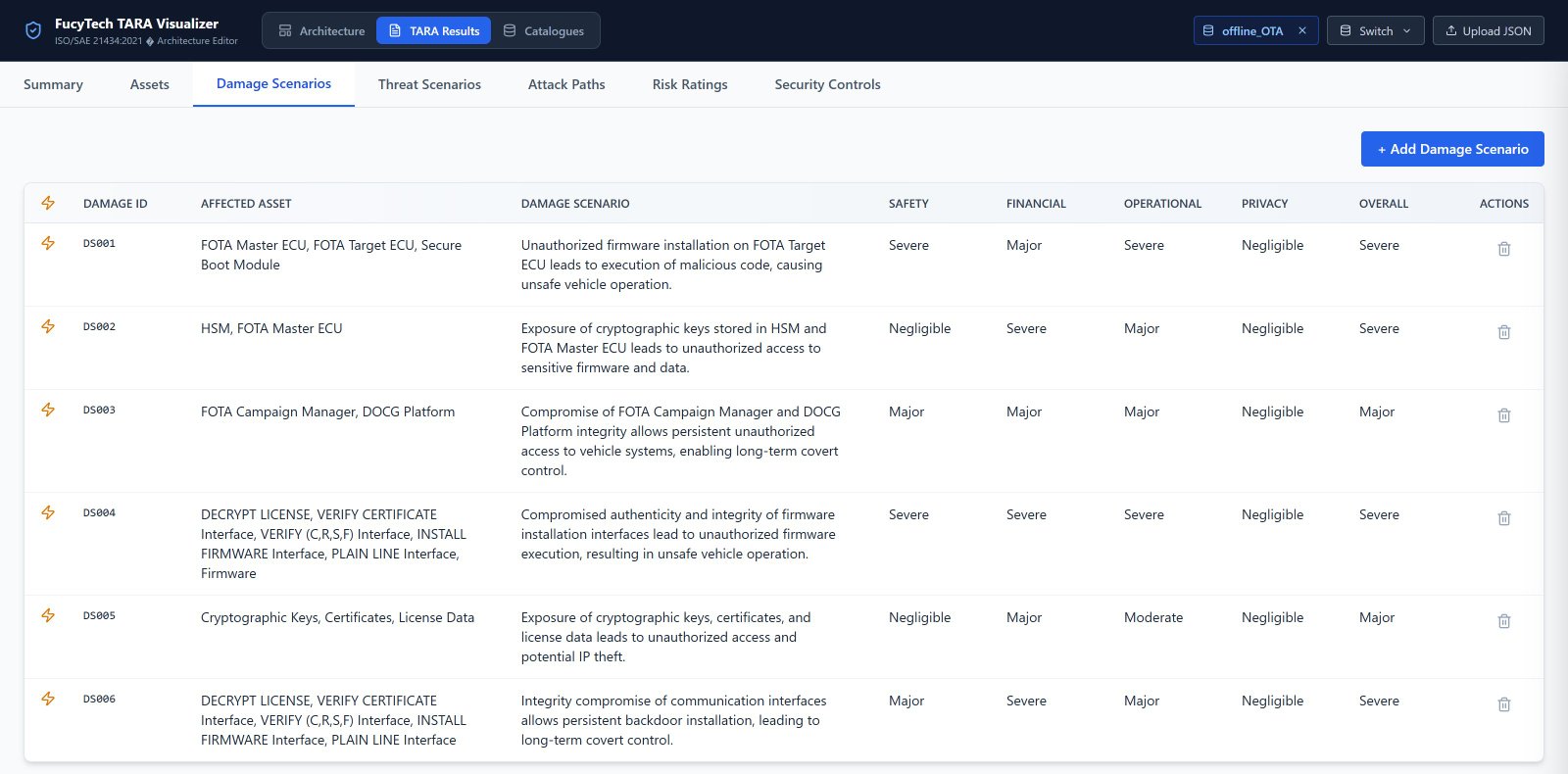
Damage scenarios rated across safety, financial, operational and privacy impact, with the overall rating derived automatically.
Six sections of ISO/SAE 21434 TARA, end to end
Each step feeds the next, so threats trace back to assets and controls trace back to risks.
Asset identification
Assets and their cybersecurity properties are derived from the ECU's functions and interfaces.
Damage scenarios
Safety, financial, operational and privacy impacts rated for each asset.
Threat scenarios
STRIDE applied systematically to every damage scenario.
Attack paths
Step-by-step paths with attack feasibility, extra paths for high-risk threats.
Risk rating
Impact × feasibility matrix gives a risk value and a treatment decision.
Controls
Cybersecurity goals and controls mapped to each unacceptable risk.
Describe the ECU. The engine does the rest.
Start from a short JSON definition or draw it on the canvas. Leave the asset list empty and TARA Engine identifies the assets for you.
- Configurable depth: set minimum damage categories, STRIDE coverage and paths per threat without code changes.
- Your knowledge base: add standards, threat databases and anonymised past reports as PDF, DOCX, TXT or Markdown.
- Regenerate on change: edit the architecture and re-run the analysis in one click.
// data/input/can_gateway.json
{
  "ecu_name": "CAN Gateway ECU",
  "vehicle_system": "Powertrain",
  "functions": ["Route CAN messages",
                "Firewall filtering"],
  "interfaces": {
    "can": ["HS-CAN", "MS-CAN", "LIN"],
    "ethernet": ["100BASE-T1"],
    "debug": ["JTAG", "UDS over OBD-II"]
  },
  "assets": []  // identified automatically
}
Built around the regulations you're audited against
Structure, terminology and traceability follow the standards, so your reports are ready for assessors and type-approval authorities.
Road vehicles: cybersecurity engineering
- Clause 15 TARA methods: asset identification through risk treatment
- Impact ratings across safety, financial, operational and privacy
- Attack feasibility rating and risk value determination
- Cybersecurity goals and claims linked to each risk
Cybersecurity management system
- Built-in Annex 5 threat and mitigation catalogue
- Link generated threats to R155 threat categories
- Compliance gap view highlights uncovered threats
- Evidence ready for the CSMS and type-approval process
From gateways to high-voltage batteries
TARA Engine works on any ECU you can describe. These are a few we use as reference cases.
Central gateway
CAN and Ethernet routing, firewall rules, diagnostic access over OBD-II.
Telematics unit
Cellular connectivity, remote services and over-the-air updates.
ADAS controller
Sensor fusion, emergency braking and lane keeping with V2X inputs.
Battery management
Cell monitoring, charging control and thermal protection for HV packs.
Every analysis exports to the formats your team already uses.
See TARA Engine run on one of your own ECUs
Book a 30-minute walkthrough with our automotive cybersecurity team.
Or email us directly at cybersec@fucytech.com